Difficulties in raw material procurement, weak downstream demand, medium-heavy rare earth production down MoM in May [SMM analysis]

Published: May 31, 2025 22:26
[SMM Analysis: Difficulties in Raw Material Procurement, Weak Downstream Demand Lead to MoM Decline in Medium-Heavy Rare Earth Production in May] In May 2025, China's production of medium-heavy rare earth oxides experienced a relatively significant MoM decline. The most critical reason for this situation was the simultaneous shortage of ion-adsorption ore from Southeast Asia and NdFeB scrap. This shortage had a direct impact on the operating rates of separation plants and scrap recycling enterprises, leading to a significant reduction in their oxide production.

SMM May 31 report: In May 2025, China's production of medium-heavy rare earth oxides saw a significant QoQ decline. The most critical reason for this situation was the simultaneous shortage of ion-adsorption ore from Southeast Asia and NdFeB scrap. This shortage had a direct impact on the operating rates of separation plants and scrap recycling enterprises, leading to a significant reduction in their oxide production.

Firstly, from the perspective of ion-adsorption ore in Southeast Asia, due to the continuous sluggishness of market prices, suppliers in regions such as Myanmar generally adopted a wait-and-see attitude and were unwilling to sell their ion-adsorption ore at this time. This mindset led to a substantial decrease in the circulation of ion-adsorption ore in the market, which in turn made it more difficult for separation plants to procure raw materials. At the same time, the implementation of export control policies also suppressed, to a certain extent, downstream demand for medium-heavy rare earth raw materials. Additionally, the delay in issuing mining quotas made separation plants more cautious in procuring ion-adsorption ore, unwilling to readily accept high-priced ore to avoid increasing their operational risks.
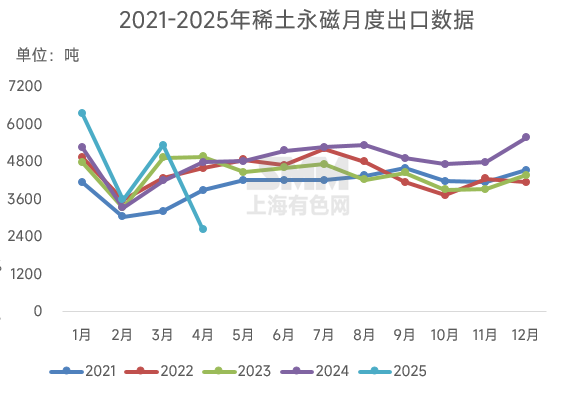
Secondly, the shortage of NdFeB scrap is also not to be overlooked. The export control policies not only affected the market for ion-adsorption ore but also had a significant impact on magnetic material enterprises. These enterprises had to face production cuts due to the influence of the export control policies. The direct consequence of the production cuts was a reduction in the generation of scrap. Due to the shortage of raw materials, the production of rare earth oxides by scrap recycling enterprises also showed a significant downward trend. Under the combined effects of the above situations, this ultimately led to a QoQ decline in China's production of medium-heavy rare earth oxides.

》Apply for a free trial of SMM Metal Industry Chain Database
Data Source Statement: Except for publicly available information, all other data are processed by SMM based on publicly available information, market communication, and relying on SMM‘s internal database model. They are for reference only and do not constitute decision-making recommendations.

For any inquiries or to learn more information, please contact: lemonzhao@smm.cn
For more information on how to access our research reports, please contact:service.en@smm.cn
Related News
Frontier Secures $20 Million and Signs Rare Earth Offtake Agreement
Feb 6, 2026 18:46
Frontier Secures $20 Million and Signs Rare Earth Offtake Agreement
Read More
Frontier Secures $20 Million and Signs Rare Earth Offtake Agreement
Luxembourg-based Frontier Rare Earths today announced it successfully obtained a $20 million investment from South Africa's Industrial Development Corporation (IDS) and signed an offtake agreement with France's Carester. The company has now initiated the final feasibility study for its South African magnet-use rare earth and battery-grade manganese project. Frontier Rare Earths is currently advancing the development of the Zandkopsdrift project in South Africa. The project is expected to achieve an annual capacity of approximately 3,038 mt of Pr-Nd oxide, 114 mt of dysprosium oxide, and 25 mt of terbium oxide over the first 25 years.
Feb 6, 2026 18:46
US Provides $565 Million in Financing for Brazilian Rare Earth Project
Feb 6, 2026 18:43
US Provides $565 Million in Financing for Brazilian Rare Earth Project
Read More
US Provides $565 Million in Financing for Brazilian Rare Earth Project
Serra Verde, a Brazilian rare earth element producer, announced today that the US International Development Finance Corporation (DFC) offered it a financing package worth $565 million, which also includes an option for the US government to acquire a minority stake in the company. Serra Verde’s Pela Ema ionic clay deposit in Brazil is scheduled to begin commercial production in 2024, with an expected annual output of 5,000 mt of total rare earth oxides, including dysprosium, erbium, neodymium, and praseodymium. Serra Verde plans to use the funds to refinance existing loan facilities and expand production capacity. The project aims to increase total rare earth oxide production to 6,500 mt per year by 2027.
Feb 6, 2026 18:43
US DFC Offers $565M Financing to Brazilian Rare Earth Project
Feb 6, 2026 18:42
US DFC Offers $565M Financing to Brazilian Rare Earth Project
Read More
US DFC Offers $565M Financing to Brazilian Rare Earth Project
[SMM Flash: US Provides $565 Million in Financing for Brazilian Rare Earth Project] Serra Verde (a Brazilian rare earth element producer) announced today that the US International Development Finance Corporation (DFC) has provided it with a financing package worth $565 million, which also includes an option for the US government to acquire a minority stake in the company. Serra Verde's Pela Ema ionic clay deposit in Brazil is scheduled to commence commercial production in 2024, with an expected annual output of 5,000 mt of total rare earth oxides, including elements such as dysprosium, erbium, neodymium, and praseodymium. Serra Verde plans to use the funds to refinance existing loan facilities and expand production capacity. The project aims to increase the annual production of total rare earth oxides to 6,500 mt by 2027.
Feb 6, 2026 18:42